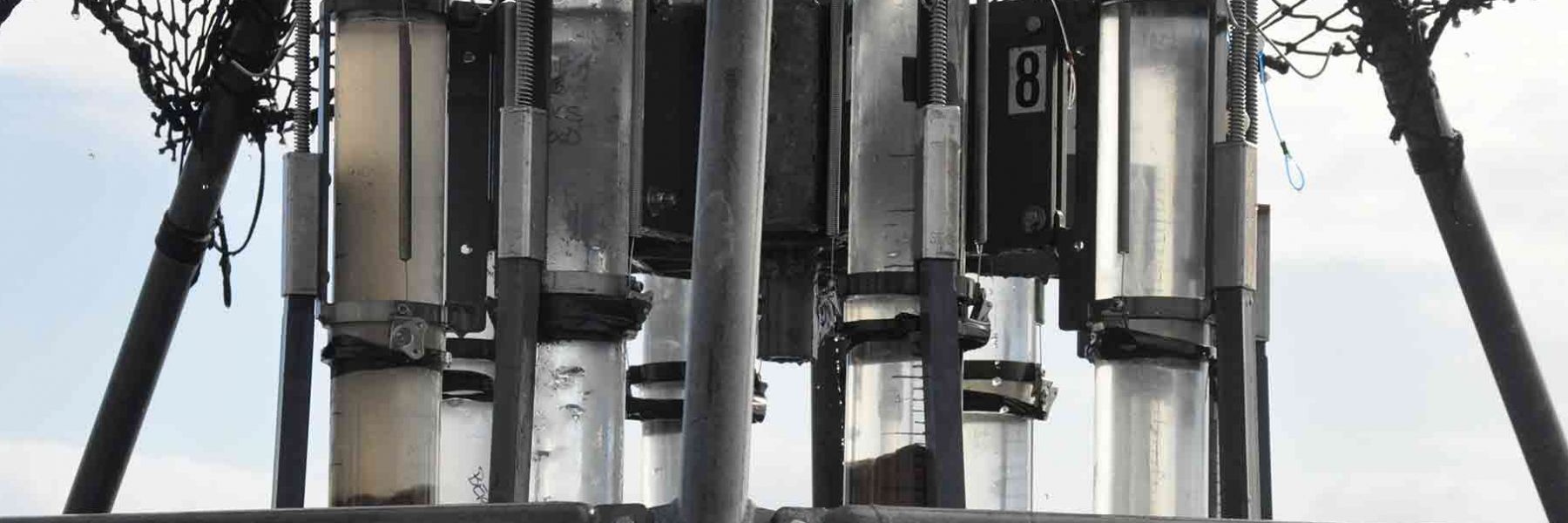
Credit: Alyson Santoro

Changes in the Earth's coupled ocean-atmosphere system are among the most pressing issues facing science and society. IGPMS students and faculty are at the leading edge of this research using the latest empirical, observational, and modeling approaches to understand the response of the Earth system to global climate change, now and in the past. Examples of research in this area include developing satellite remote sensing tools to understand carbon export, measuring how ocean currents affect the distribution of carbon and other nutrients, reconstructing ocean circulation from paleoclimate records, and using trace gases to understand the biogeochemical cycling of carbon. Modelers use inverse models to understand the exchange of carbon and heat between the ocean and atmosphere, and global ocean and climate models to understand the ocean's role in large-scale climate variability and future climate change.

Affiliated Faculty

Professor
The power of plankton.
Distinguished Professor
Marine Bioinorganic Chemistry and Metallobiochemistry.
Professor
I am a microbial oceanographer that studies the interaction between microbes and the biogeochemical processing of marine organic matter.
Professor
The DeVries lab studies the interaction of ocean circulation, carbon cycle, and climate.
Debora Iglesias-Rodriguez has worked for twenty years on diversity and function in marine phytoplankton combining molecular approaches, carbon physiology and biogeochemistry in the lab and in the field.
Assistant Professor
Wind energy, conductivity sensing, drag reduction using superhydrophobic surfaces, cohesive sediment.
Professor
Limnology and Coastal Oceanography, with particular emphasis on physical-biological coupling.
Professor
Ecological processes in lakes, wetlands and streams and their catchments throughout the world.
Assistant Professor
Uses mathematics, experiments, and field observations to understand how metabolic interactions between species shape the structure and function of ecological communities.
Associate Professor
Chair, IGPMS
Program Diversity Officer
Coastal physical oceanography and autonomous platforms.
Associate Professor
Vice Chair and Faculty Graduate Advisor, IGPMS
Sulfur biogeochemistry and organic matter cycling in the ocean.
Professor
Marine microbial ecology, nitrogen cycling.
Professor
Physical oceanographic / ecological coupling, biogeochemistry and coastal spatial ecology using the tools of an applied physicist, radiative transfer and fluid mechanics.
Professor
Our lab investigates how coastlines evolve over thousands of years.
Assistant Professor
Climate and ocean modeling, tropical Pacific climate dynamics, and long-term variations in hydroclimate.
Professor
Carbon Climate, Marine Organisms Genomics.
Professor
Paleoclimate, paleoceanography, proxy development and refinement